Difference Between Castors and Wheels: Why One Can Swivel

Wheels and castors are both used to make equipment easier to move. But they are not the same thing. If you want to know the difference between castors and wheels, then read this guide.
A wheel is the round component that rotates and rolls against a surface. In contrast, a castor, also spelled caster, is a complete wheel assembly that includes a wheel and a mounting system.
Depending on the type, a castor can be fixed in one direction, swivel around a vertical axis, or include a brake. Knowing how wheels and castors differ makes it easier to choose the right option for trolleys, carts, scaffolding, furniture, and industrial equipment.
To clear up your confusion, I’ve covered the topic in detail. After reading this guide, you’ll understand the key differences between castors and wheels. Let’s get into the details.
Difference Between Wheels and Castors: Quick Comparison Table
The simplest way to remember the difference is: A wheel is the part that rolls. A castor is the complete assembly that holds the wheel and attaches it to equipment. So, every castor contains a wheel. But not every wheel is a castor.
Here is a comparison table:
|
Feature |
Wheel |
Castor |
|
Basic function |
Provides rolling movement |
Supports and moves equipment |
|
Construction |
Circular rotating component |
Wheel and mounting assembly |
|
Mounting system |
Usually requires an axle or frame |
Includes a plate, stem, or other mount |
|
Swivelling |
Does not swivel by itself |
Can swivel if it is a swivel castor |
|
Brake |
Usually separate |
Can have an integrated brake |
|
Direction |
Single |
Fixed or swivel |
|
Common uses |
Vehicles, machinery, rollers |
Trolleys, carts, scaffolding, furniture |
|
Installation |
Requires an independent axle or shaft |
Attaches directly to the bottom of an object |
What Is a Wheel?
A wheel is a circular component designed to rotate around an axle. As it rotates, it allows an object to move across a surface with less friction. A wheel moves in one direction along one path and can't swivel.
Standalone wheels only roll forward and backward in a fixed straight line. Because of this, wheels cannot change direction on their own. Having said that, you can still change its direction by steering or manually moving the equipment.
The wheel itself does not normally provide a mounting system for attaching it directly to equipment. Instead, it is fitted to an axle, frame, or another assembly. Wheels are available in different materials and designs depending on the application.

Common Types of Wheels
-
Rubber wheels: Suitable for applications where quiet movement and floor protection are important.
-
Polyurethane wheels: Offer good wear resistance and are commonly used on industrial equipment and material-handling products.
-
Nylon wheels: Lightweight and resistant to moisture, making them useful in many industrial environments.
-
Steel wheels: Designed for demanding applications where high strength and durability are required.
-
Pneumatic wheels: Filled with air and useful on uneven outdoor surfaces because they can absorb shocks and bumps.
The wheel material, diameter, width, and bearing type all affect how easily it moves and how much weight it can support. So, when you buy a wheel, you have to consider all these factors to make sure it is suitable for your equipment and application.
What Is a Castor?
A castor is a complete wheel assembly designed to be attached to equipment. In simple words, a castor is a wheel with a mounting system that helps equipment move. It normally contains a wheel, axle, fork or housing, and mounting system.
Depending on the type and design, a castor may also include a swivel mechanism, mounting plate, stem, brake, wheel lock, or swivel lock. In contrast to wheels, castors can move in multiple directions and are ready to attach to a trolley, cart, rack, machine, scaffold, shelves and hospital equipment.

What Are the Common Types of Casters?
Some of the common types of casters are the following:
Rigid Casters
Rigid casters, also called fixed casters, have a wheel that stays in one position and does not swivel. Because of this, they move mainly in a straight line. Fixed casters are a good choice when you need stable and controlled movement, such as on carts, trolleys, and industrial equipment.
Swivel Casters
Swivel casters allow the wheel assembly to rotate 360° around a vertical axis. This lets the equipment change direction without having to lift or reposition it. They are useful when you need better manoeuvrability, especially in tight spaces. You can find them on trolleys, carts, chairs, furniture and workshop equipment.
Some swivel castors include brakes. Depending on the design, the brake can stop the wheel from rolling, lock the swivel movement, or do both. Swivel castors with brakes are useful when equipment needs to remain stationary during use or loading.
Leveling Casters
Leveling casters combine the mobility of a castor with a leveling function. You can roll the equipment into the required position and then use the leveling mechanism to raise or lower it and keep it stable. Levelling casters are commonly used on machinery, workbenches, equipment stands, scaffolding, and other applications where both mobility and stability are needed.
Industrial Casters
An industrial castor is designed for moving equipment in demanding working conditions. They usually have a strong frame, larger wheels, and higher load capacity than standard castors. Industrial castors are available in different wheel materials, sizes, and load capacities, so you can choose one based on your equipment and working environment. Industrial castors are useful for machinery, industrial carts, heavy equipment, trolleys, workshop equipment, warehouse equipment, and material-handling equipment.
Are Castors and Casters the Same Thing?
Yes. Castor and caster generally refer to the same type of wheel assembly.
The difference is mainly spelling:
-
Castor is widely used in British English.
-
Caster is more common in American English.
You may therefore see terms such as castor wheels, caster wheels, industrial castors, or industrial casters describing similar products.
Why Are They Called Castor Wheels?
The word “castor” comes from the Old English word casten, which means “to throw” or “to turn.” The name refers to the ability of castor wheels to turn and move objects in different directions. The term became commonly associated with rotating and swivelling wheels in the 17th century. The name is now commonly used for the complete wheel assembly attached to furniture, carts, equipment, and machinery.
How to Measure Caster Wheels?
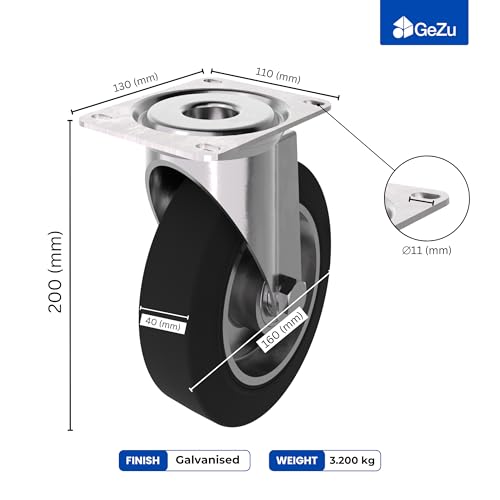
If you want to replace or buy caster wheels, you need to measure them correctly to make sure the new ones fit your equipment. You should measure the wheel diameter, wheel width, overall height, mounting plate size, and bolt-hole spacing. You can do this easily using a measuring tape.

Measure Wheel Width & Diameter
When measuring the wheel size, you need to check two measurements: diameter and width. To measure the diameter, place the wheel so you can measure from one edge to the opposite edge through the centre. Make sure your measuring tool passes through the centre of the wheel for an accurate measurement. For example, if the wheel measures 9 inches across, it is a 9-inch caster wheel.
To measure the wheel width, position the wheel upright and measure from the outside of one side to the outside of the other side. This gives you the total width of the wheel and helps you choose a replacement that fits correctly.
Measure Overall Caster Height
The overall caster height is the distance from the floor to the top of the mounting plate or mounting point. Place the caster on a flat surface and measure vertically from the floor to the highest point of the caster. This measurement is important because the caster height affects the overall height of your equipment. Make sure the replacement caster has a suitable overall height so it fits properly and does not change the working height of your equipment.
Measure Top Plate and Bolt Hole Pattern
The top plate is used to attach the caster to your equipment or another object. Since top plates come in different sizes, you need to measure the available mounting area and the existing top plate. Measure from the outside edge to the opposite outside edge of the plate for the length, then repeat the same process across the perpendicular side for the width.
To measure the bolt hole pattern, measure from the centre of one mounting hole to the centre of the opposite hole. Take the measurement in both directions to get the length and width of the bolt hole pattern. This helps you make sure the new caster matches the existing mounting holes.
Check Load Capacity
After taking all the measurements, one last thing you also need to check is the load capacity of the caster. You cannot ignore the load capacity when choosing caster wheels. Some casters are made for light-duty applications, while others are designed for heavy-duty use. If your equipment or object is heavy, you need to check the caster's load capacity and make sure it can safely support the weight.
Types of Caster Wheels We Supply
We provide plate-mounted fixed castors in two sizes: 200 x 40 mm and 160 x 40 mm. The 200 x 40 mm caster has a 450 kg load capacity that is suitable for heavier equipment and applications. The castors feature solid rubber wheels, which provide smooth movement. They are also anti-vibration and anti-marking, so they help absorb shocks and protect your floors from scratches and marks.
The caster wheels come with a 130 x 110 mm mounting plate and have an overall height of 240 mm. Before choosing a caster, make sure the size and load capacity match your equipment.
Buy Caster Wheels Online at GeZu Impex
You can buy caster wheels online from GeZu in two sizes. Our solid rubber plate-mounted castors are suitable for light- and heavy-duty applications, depending on the model. We deliver across Europe, so you can order the caster wheels for your equipment and have them delivered to your location.
Final Verdict: Wheel vs Castor
The difference between a wheel and a castor is straightforward. A wheel is the component that rolls, while a castor is the complete assembly that holds the wheel and attaches it to equipment.
Choose a standalone wheel when you already have a suitable axle or mounting system. Choose a castor when you need a complete wheel assembly for a trolley, cart, scaffold, machine, furniture, or other equipment.
FAQ
What Type of Casters Are Best?
The best casters depend on the application. Consider the required load capacity, wheel diameter, wheel material, floor surface, mounting type, swivel or fixed design, and brake requirements before choosing a caster.
Are Casters Just Wheels?
No. Casters are complete wheel assembly that includes the wheel and its mounting system. They may also have bearings, a swivel mechanism, a stem, and a brake.
What Are the Parts of a Caster Wheel Called?
The main parts are the wheel, axle, fork or housing, mounting plate or stem, bearings, and swivel mechanism. Braked casters may also include a wheel brake or lock mechanism.
Are Wheels and Castors Interchangeable?
No, they are not interchangeable. A wheel is the rolling component, while a castor includes the wheel along with a mounting frame or housing that attaches it to the equipment.
Do All Castors Swivel?
No. Fixed castors do not swivel. Swivel castors can rotate around a vertical axis and allow equipment to change direction easily.