Best pipe fittings for greenhouse frames 2026: ranked

For a DIY greenhouse frame built from galvanised steel tube, the pipe fittings decide whether the structure stays square, tight and rust-free for the next ten years. Best overall: the galvanised right angle coupler from GeZu Impex — two bolts lock a rigid 90° corner with no welding. Best for angled bracing: the swivel coupler, which clamps at any angle on sloped or uneven ground. Best ready-made option for compact frames: the Ø27 mm table frame kit, a bolt-together corner system for small builds and shelving.
- Right angle couplers are the best pipe fittings for greenhouse frames in 2026: rigid 90° corners, bolted, no welding.
- Swivel couplers take diagonal braces on sloped or uneven ground.
- Parallel couplers extend tubes for long ridge and eaves runs.
- Hot-dip galvanised fittings outlast painted steel in humid greenhouse air.
- Bolted frames can be re-tightened and moved; welded joints crack and rust first.
Why the fittings matter more than the tube
A greenhouse is a corrosion chamber: warm air, high humidity and condensation on every cool surface, day after day. Fittings sit exactly where moisture collects — inside the clamp, around the bolt, in the crevice between fitting and tube. A cheap painted fitting starts rusting there within the first seasons, and rust swells inside the clamp until the joint loosens.
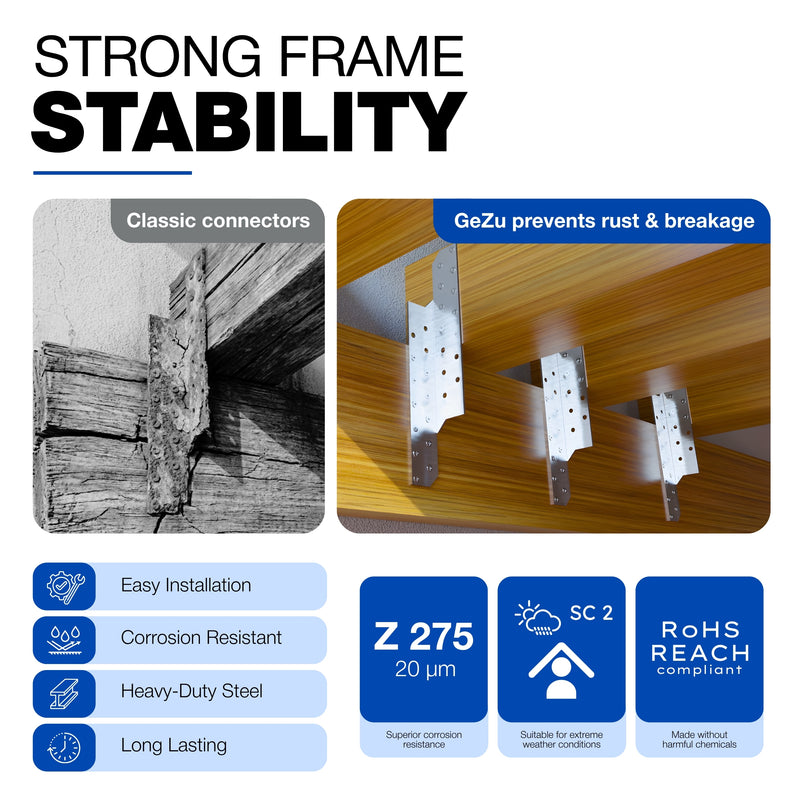
Galvanising solves this the metallurgical way. The zinc layer corrodes first and protects the steel beneath it, so a hot-dip galvanised fitting keeps its grip long after a painted one has stained the tube. In 2026 this matters more than ever for DIY builders, because most greenhouse kits sold online still arrive with lightly plated hardware that was never meant for permanent humidity.
The second reason is structural. A greenhouse frame lives on its corners: ridge to post, eaves to wall plate, brace to upright. Every one of those joints is a pipe fitting, and every one is a place where the frame can rack out of square. Bolted fittings hold the geometry and let you re-tighten a joint that works loose — something a welded frame cannot offer.
What makes the best pipe fitting for a greenhouse frame
- Corrosion protection: hot-dip galvanised steel as the baseline, because condensation attacks uncoated and lightly plated fittings first.
- Tube compatibility: standard scaffold tube is 48.3 mm outside diameter; lighter builds use 27 mm or 33.7 mm tube — match the fitting to the tube, not the other way round.
- Joint rigidity: two-bolt clamp fittings hold angles under wind load; single-bolt fittings creep loose over a season of wind.
- Angle range: fixed 90° for the main frame, swivel for braces where the angle is never exactly 90°.
- No-weld assembly: a bolted fitting needs an Allen key or a 22 mm spanner, not a welder, and the frame can be dismantled and moved.
- Load path: fittings should carry load in compression and shear along the tube, not hang loads off a single bolt.
Greenhouse frame fittings compared at a glance
| Fitting | Best for | Standout feature | Key limitation |
|---|---|---|---|
| Right angle coupler | Frame corners | Rigid 90° joint with two bolts | Fixed angle only |
| Swivel coupler | Diagonal braces | Clamps at any angle | Bulkier than a fixed fitting |
| Parallel coupler | Extending tube runs | Sleeves two tube ends in line | Inline joint only, no angle |
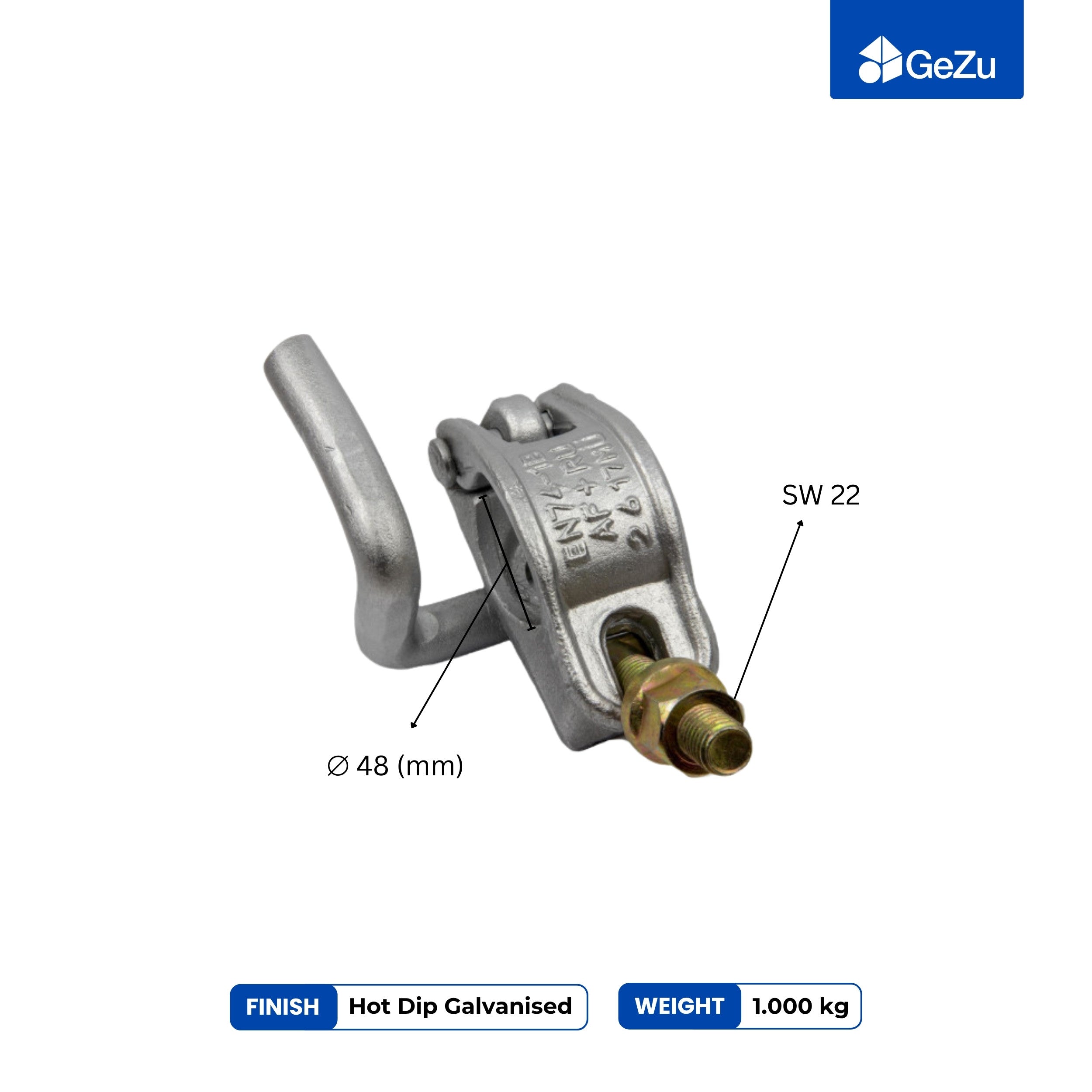
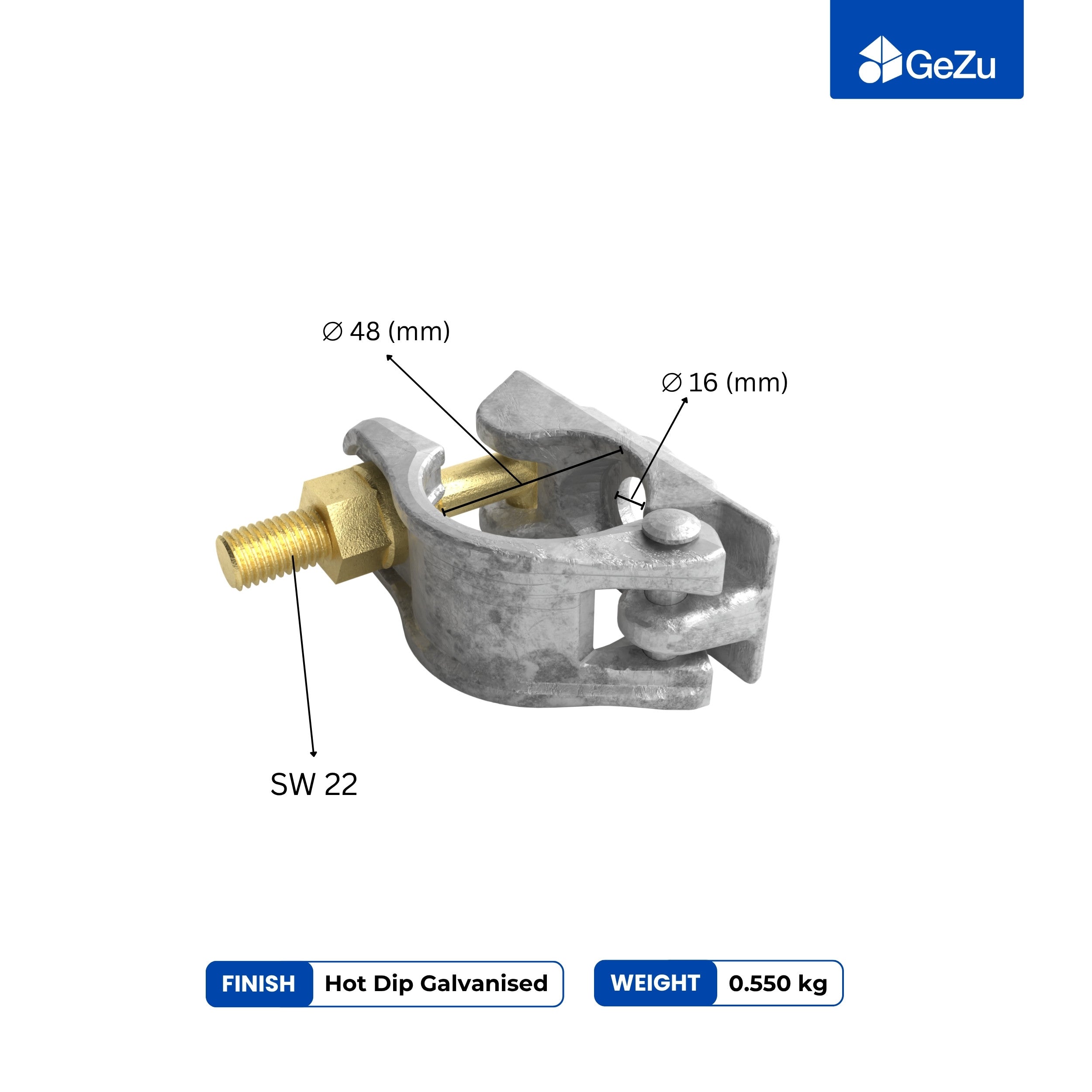
| Half coupler | Purlins, shelf rails, fixing points | Slim one-sided grip | Lower clamping force than a full coupler |
| Table frame kit Ø27 mm | Small greenhouses and cold frames | Complete bolt-together kit | Sized for 27 mm tube, not 48.3 mm |
1. Right angle coupler: best pipe fitting for greenhouse corners
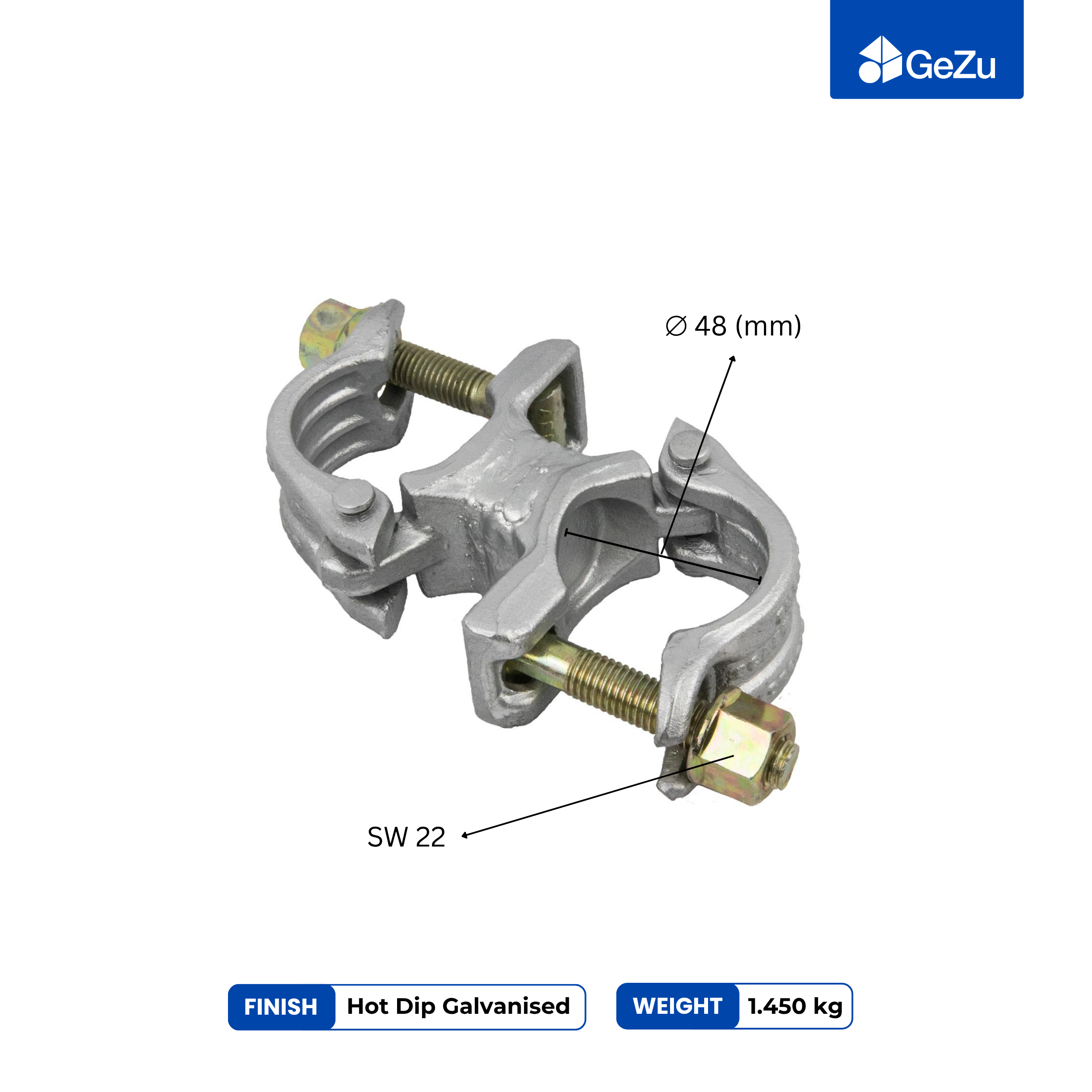
The right angle coupler joins two tubes at a fixed 90° and is the fitting that appears most often in a greenhouse frame: posts to eaves rails, eaves rails to ridge posts, door frames to uprights. Its drop forging grips both tubes with two bolts, so the joint resists both twisting and pull-out — exactly the two forces wind puts on a glazed frame.
The right angle coupler from GeZu Impex is galvanised for permanent outdoor exposure and sized for standard 48.3 mm scaffold tube, which makes it equally at home on a greenhouse, a carport or a cloche frame.
Right angle coupler pros:
- Rigid 90° joint that keeps the frame square under wind load
- Two-bolt clamping grips both tubes without drilling or welding
- Hot-dip galvanised finish for humid greenhouse conditions
Right angle coupler cons:
- Fixed angle — useless where the geometry is not exactly square
- Heavier and costlier than a simple corner bracket for light-duty frames
Verdict: Buy. It is the workhorse fitting for any welded-free greenhouse frame in 2026.
2. Swivel coupler: best for bracing on uneven ground
Real gardens are not flat. When the frame meets sloping ground or you run a diagonal brace from an eaves rail down to a mid-post, the angle is never exactly 90°. A swivel coupler clamps both tubes and then rotates through any angle before the bolts are final-tightened, which absorbs every site irregularity a foundation slab would otherwise hide.
The swivel coupler fits the same 48.3 mm tube and shares the same galvanised protection, so it can be mixed freely with right angle fittings on the same frame.
Swivel coupler pros:
- Locks at any angle, not just 90°
- Turns a sloped site into a non-problem for bracing
- Same tube size and finish as fixed fittings, so parts stay interchangeable
Swivel coupler cons:
- The rotating joint is bulkier at the corner than a fixed coupler
- Slightly slower to set because both tubes swivel until torqued
Verdict: Buy for braces. Keep two or three in the box; on level ground they sit unused, on sloped ground they save the build.
3. Parallel coupler: best for extending tube runs
Greenhouse ridges and eaves rails are longer than any single tube you will buy, so runs have to be joined in line. A parallel coupler sleeves two tube ends inside one fitting and bolts through both, restoring most of the tube's strength across the joint. On a frame that flexes in the wind, this matters: a butt joint made with tape or a loose sleeve works loose within a season.
Parallel coupler pros:
- Extends any 48.3 mm tube run without welding
- The sleeve keeps the outer profile flush, so adjacent fittings still slide on
- Two-bolt grip resists rotation along the run
Parallel coupler cons:
- Inline only — it cannot carry an angle
- Adds a visible collar where a single continuous tube would look cleaner
Verdict: Buy. One parallel coupler per ridge joint and per long eaves run is the rule of thumb for a frame longer than 2 metres.
4. Half coupler: best for purlins, shelves and fixing points
Not every joint needs to clamp two structural tubes. A half coupler grips a single tube with one flat side left free, which is exactly what you want for fixing roof purlins, staging rails and shelf brackets back to the main frame. It is the quiet fitting that turns a bare tube skeleton into a working greenhouse.
Half coupler pros:
- Slim profile that sits flush against boards and rails
- Cheapest way to add a fixing point anywhere on the frame
- Enough grip for secondary members that carry no roof load
Half coupler cons:
- Not rated for primary structural joints — never use it for posts or ridges
- Single-sided grip loosens sooner if the frame is left unrestrained
Verdict: Reserve for secondary fixings. Purlins, staging and shade-rail mounts, never the main structure.
5. Table frame kit Ø27 mm: best ready-made system for compact frames
For a mini greenhouse, a cold frame on legs or a grow-house against a south wall, full-size 48.3 mm scaffold tube is overkill. A bolt-together frame kit in 27 mm tube gives you corners, tees and ends that assemble into a small rigid skeleton with a single spanner, and the whole frame still breaks down flat for winter storage.
The table frame kit from GeZu Impex is a ready-made example: a matched set of fittings in galvanised or black finish for building frames from Ø27 mm tube without any cutting or drilling of the fittings themselves.
Table frame kit pros:
- Complete kit — no hunting for individual fittings in two tube sizes
- Compact 27 mm profile suits shelves, mini greenhouses and cold frames
- Bolted assembly, dismantlable and re-usable every season
Table frame kit cons:
- Sized for 27 mm tube, so it cannot mix with 48.3 mm scaffold fittings
- A kit covers standard layouts; unusual frame geometry still needs loose fittings
Verdict: Buy for small builds. Move up to loose 48.3 mm fittings as soon as the frame carries glazing over head height.


How these fittings were ranked
The ranking applies the criteria above — corrosion protection, tube compatibility, joint rigidity, angle range and no-weld assembly — to three real greenhouse scenarios in 2026: a full walk-in frame on level ground, a lean-to on sloping ground, and a compact mini greenhouse. Each fitting sits where it earns its place in the build sequence, not where it looks best in a catalogue.
Which pipe fittings should you choose for your greenhouse?
For a walk-in greenhouse frame, start with right angle couplers at every structural corner in 2026 and add swivel couplers wherever a brace meets sloping ground. Use parallel couplers to join tube runs longer than a single length, and half couplers only for staging and purlins. For a mini greenhouse or cold frame, the Ø27 mm table frame kit replaces the whole fitting list with one box. Keep every fitting hot-dip galvanised and every joint bolted, and the frame will outlast the glazing.
FAQ
What are the best pipe fittings for a DIY greenhouse frame in 2026?
The best pipe fittings for a greenhouse frame in 2026 are hot-dip galvanised couplers for 48.3 mm tube: right angle couplers for corners, swivel couplers for braces and parallel couplers for extending runs. Together they build a rigid frame with no welding.
Can I build a greenhouse frame from pipe fittings without welding?
Yes. Clamp-type fittings grip standard scaffold tube with bolts, so the whole frame assembles with a spanner. Bolted joints can also be re-tightened, which welded joints cannot.
What size tube do greenhouse pipe fittings fit?
Standard scaffold fittings fit 48.3 mm outside-diameter tube. Lighter frame kits use 27 mm or 33.7 mm tube with matched fittings — always check the tube size before ordering.
Are galvanised fittings worth it for a greenhouse?
Yes. A greenhouse is constantly humid and condensation forms on every metal surface daily, which rusts painted or lightly plated fittings within a few seasons. Hot-dip galvanising protects the steel for decades in that environment.
How many fittings does a small greenhouse frame need?
A typical walk-in frame of six posts with eaves and ridge rails needs a right angle coupler at most corners, one parallel coupler per long run and two to four swivel couplers for bracing. Half couplers cover staging and purlins on top of that.
Can pipe fittings hold greenhouse glazing?
The fittings carry the frame, not the glazing itself. Polycarbonate or glass panels fix to the frame with clips and screws through the tube, and the fittings' job is to keep that frame rigid and square.
Do I need special tools to assemble a pipe fitting frame?
No. Clamp fittings tighten with a standard spanner or Allen key, depending on the bolt type. That is the main advantage over a welded frame, which needs a welder and a power supply on site.
One last detail
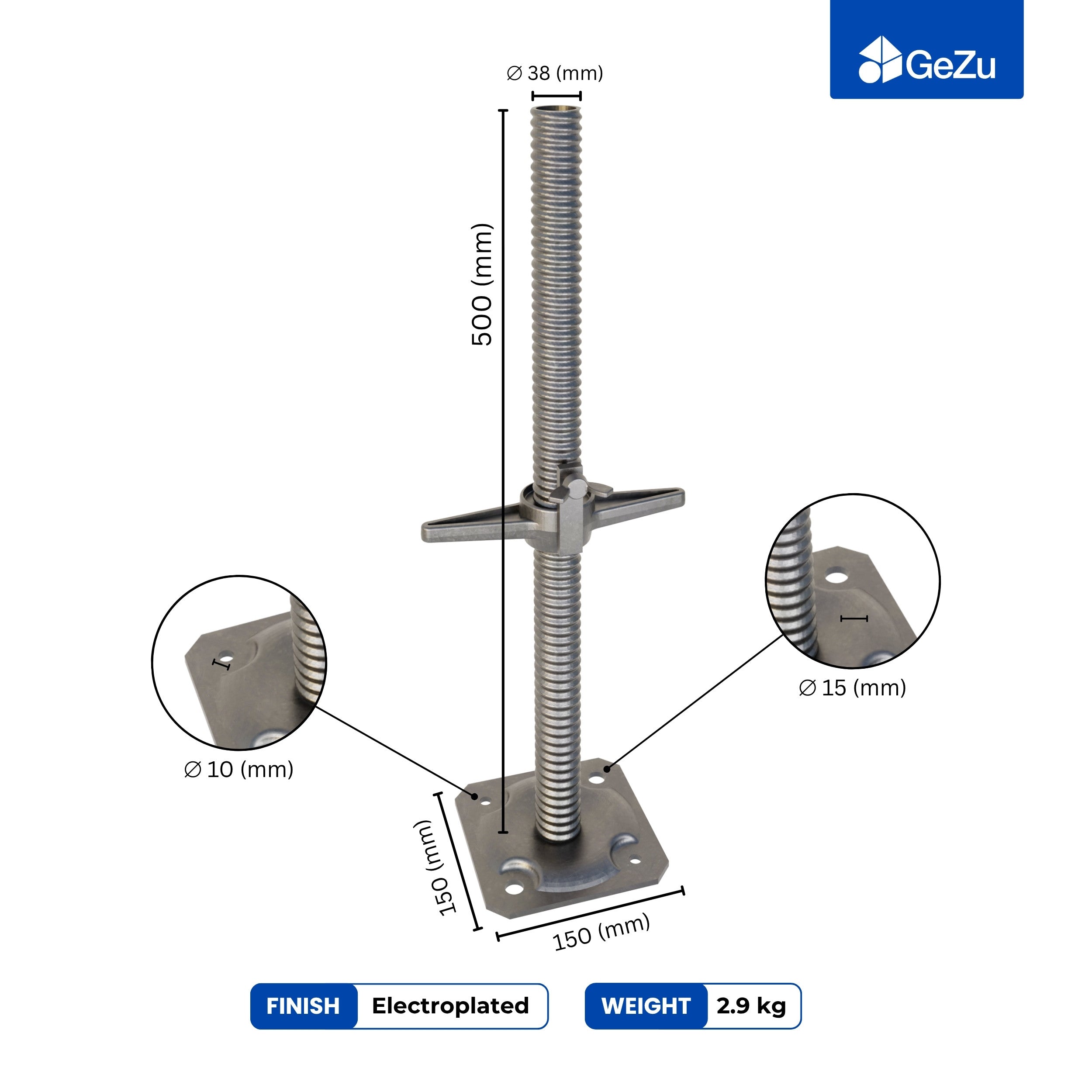
The joint that fails first on a DIY greenhouse is rarely a pipe fitting at all — it is the connection between the frame and the ground. A frame bolted to nothing more than soil works loose as the ground moves through wet and dry seasons, and every racking cycle transfers up into the fittings. Give the four corner posts a concrete footing, a ground anchor or a bolt-down base plate before the first panel goes on, and the fittings above will do their job for a decade.